
Bread and Circuses
Football: from distraction to instruction

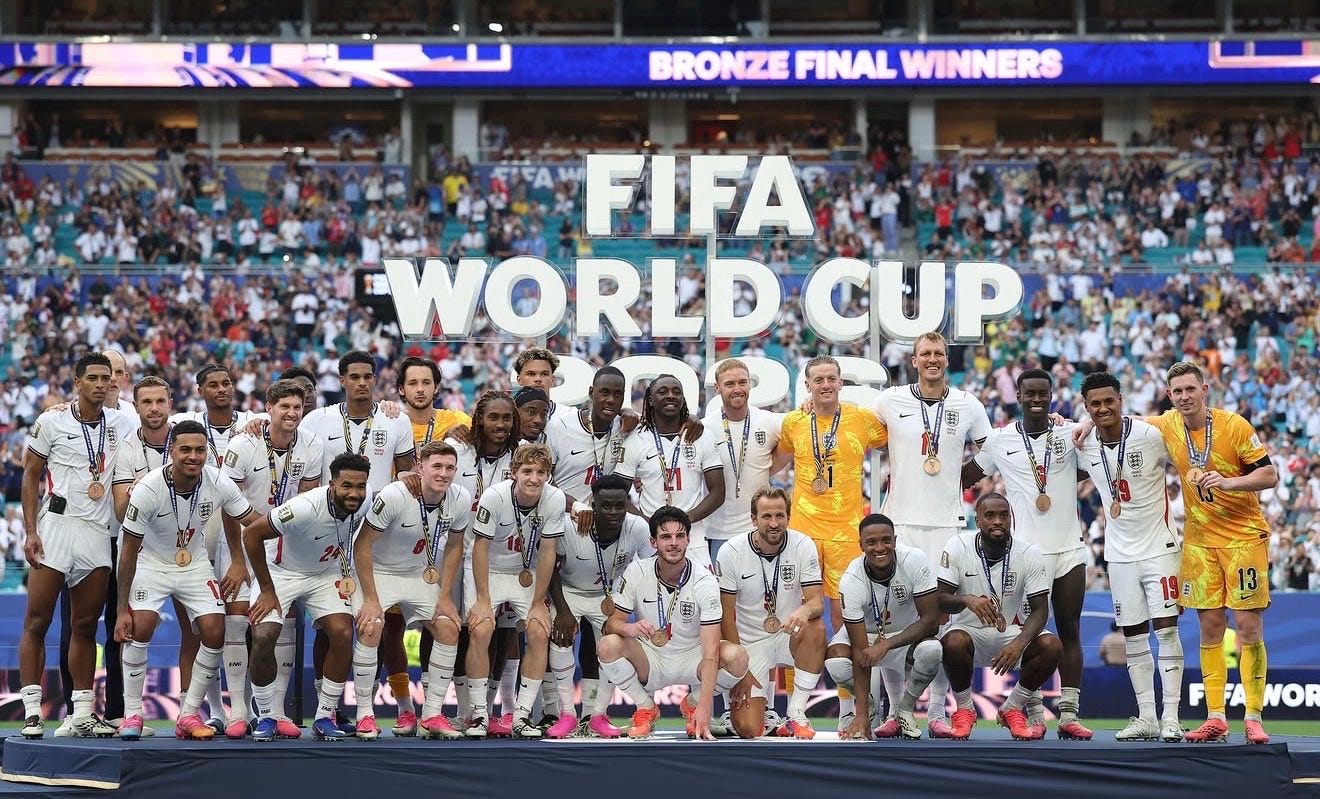
The World Cup final takes place this evening. Yesterday, England beat France to achieve the team’s best result at a World Cup since it won the tournament in 1966. However, not everyone is pleased with the England team this year. As questions over what it means to be English have become more prominent in public discourse, the England team has been dragged into the conversation.
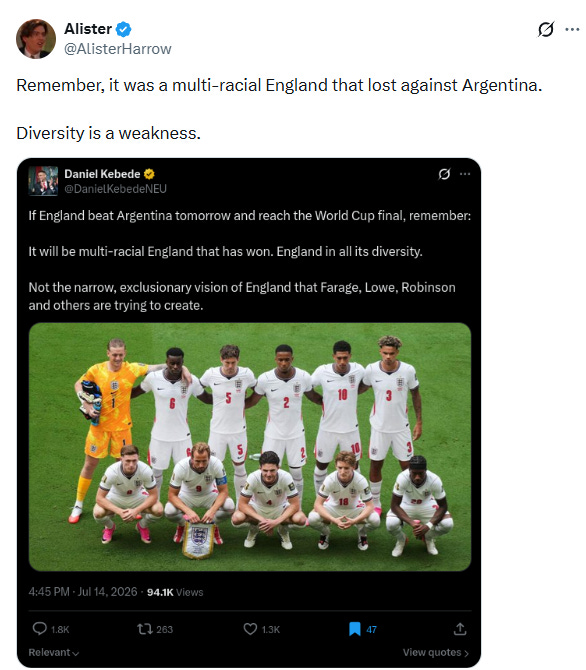
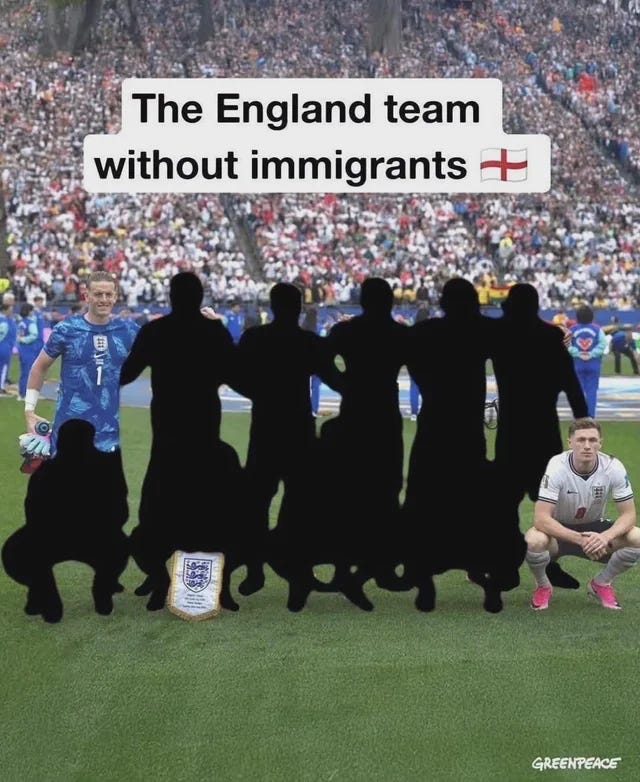
Many of the team’s players are not ethnically English. Others are mixed race, being partially ethnically English. Both the right and left of the political spectrum have made this a topic of discussion. The left argues “diversity is our strength” and that England owes its success to its “diverse” players. The ethnically conscious right wishes the team was composed of ethnically English players and contests the idea that the England team cannot be successful without “diverse” players.
It has long been argued that football is a form a “bread and circuses”, diverting the English public’s attention away from politics and channelling their energy into something which does not threaten the political establishment. But the injection of political messaging into the game over the past decade or so has turned football into less of a distraction and more of a didactic mechanism. Spectators have been lectured on the importance of movements like BLM, feminism and gay rights. It is therefore unsurprising that there would be an eventual backlash.
Bread and circuses
The Roman satirist Juvenal is credited with originating the phrase “bread and circuses” in his Satire X, written in the early 2nd century AD. The relevant lines are the following:
They shed their sense of responsibility
Long ago, when they lost their votes, and the bribes; the mob
That used to grant power, high office, the legions, everything,
Curtails its desires, and reveals its anxiety for two things only,
Bread and circuses.
Here, bread and circuses refer to specific things. ‘Bread’ refers to the annona, the practice in Ancient Rome where rulers provided free wheat to eligible citizens. Circuses refers to the public games of entertainment.
A starving populace is naturally more likely to be dissatisfied with their rulers and revolt. Entertainment keeps the population distracted from their problems and directs energy away from political organising.
Nowadays, the phrase is usually used to refer to all the forms of entertainment which grab people’s attention and distract them from politics. It is less frequently used to refer to the food subsidy portion of the phrase. This is rather curious in Britain where the current Labour government very transparently uses initiatives like free school breakfasts to bribe voters.
Much has been said and written about the energy, especially young, male energy, which is diverted into enthusiasm for sports, and football in particular, instead of political pursuits. Every now and then, the line “imagine if they put this much effort into [insert political objective]” circulates on social media, attached to a video or photo of British football fans.
This criticism is somewhat unfair. Whatever one may think of them otherwise, it was football hooligan-aligned groups like the EDL who were among the first to raise the issues of the grooming gangs and Islamic extremism.
The middle class is easy to propagandise through university education. The working class, from which the core football support base comes, is harder. They have long been the last holdout against acceptance of multiculturalism and other socially liberal ideas. It is perhaps for this reason that in recent years football has become a particularly noticeable vector of pro-multicultural, anti-racist, pro-LGBTQ+ and feminist messaging.
Taking the knee
The year 2020 is when the “bread and circuses” of football entertainment really flipped from primarily distraction to primarily instruction. After George Floyd’s death in the US, seemingly every company and institution bent over backwards to show allegiance to the Black Lives Matter cause. Football was not exempt.
Premier League teams and the England team started taking the knee before matches, copying the symbolic gesture initiated by NFL player Colin Kaepernick in the US in 2016. The adoption of this gesture was not universally well received.
There is an element of genuine racism among some football fans, that cannot be denied. But it wasn’t because they were all driven by racism that many football fans did not appreciate this act. Instead, they didn’t want to be lectured about identity politics during their downtime. As the “circuses” in “bread and circuses”, football is how many British men and women choose to distract themselves from whatever problems they have in their life or there are in the wider world.
Around the same time, the inclusive LGBTQ+ flag began to be flown at matches and displayed in the corners between the stands. Football radio shows ramped up the amount of airtime given to discussions of sexism and racism in the game. Ad breaks at half time featured public education campaigns on how various -phobias and -isms weren’t acceptable. Women’s sports were heavily marketed to the public as being just as good as men’s sports. Football, in particular, was very obviously being used as a vehicle to push certain social attitudes onto the public.
Containment
This all occurred against a backdrop where patriotism is heavily discouraged.
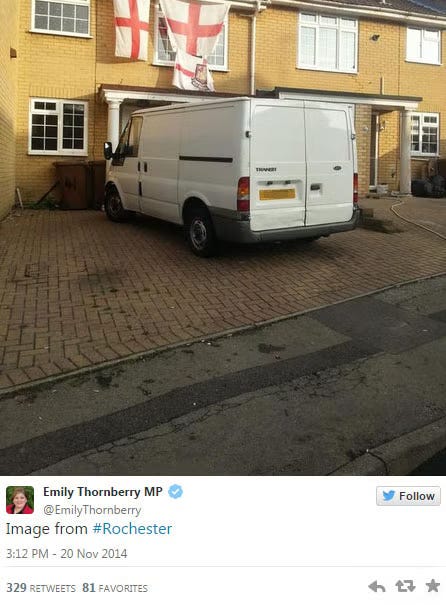
In 2014, in a tweet which has since become infamous, Labour MP Emily Thornberry mocked a house with a white van outside for flying an England flag. The message from the political class was clear: if you’re patriotic, you’re lower class; being lower class is a bad thing and we look down on you.
Since 2014, the pressure on British people to be ashamed of, rather than proud of, our country has grown. We are encouraged to feel shame over our country’s past through our school and university curricula and the relentless focus on all the worst elements of colonialism in TV shows and books.
Even our flag itself was portrayed to younger generations as an exclusionary symbol and a source of shame. We were told any sign of national pride, such as an England flag flying outside a pub, was a racist dog whistle. Simultaneously, minorities have been encouraged to feel proud of their identity. In one particularly notorious example from last year, a girl who wore a Union Jack dress was sent home from her school’s “Culture Celebration Day” and banned from giving her speech about why British culture is important to her. All cultures can be celebrated except British culture.
When British patriotism is permitted, it is only in a way which has been approved by the authorities. Football is usually this vehicle. English people are allowed a few football matches per year where we can express pride in our country. And it must be pride in the diverse vision of our country.
Diversity is our strength
The holy mantra of the social justice movement is “diversity is our strength”. Every possible opportunity to point to an integration success story is used as an example to prove this statement to be true.
As England’s population has become more ethnically diverse, so has its football team. But it’s not just England, across Europe there is a phenomenon where national football teams feature players who have no ancestral ties to the nation they are representing. This has left many asking the question of what the point of having national football teams is.
To give two examples, England’s Buyako Saka was born in London to Nigerian parents and France’s Kylian Mbappé was born in Paris to a Cameroonian father and a mother who was born in Paris to Algerian parents. As talented as they may be, are these men really English and French when they have no English or French ancestry respectively? And is it wrong for English or French people to want to see ethnically English or French people representing their nations on the pitch?
There’s also a sort of Schrödinger’s football player logic. Saka is as English as an ethnically English player and it is unacceptable to point out that he is not English in the same sense as someone with English ancestry. Unless he is responsible for a good result. In that case, it is his diversity, the very fact of not being ethnically English, that makes him a necessary addition to the team.
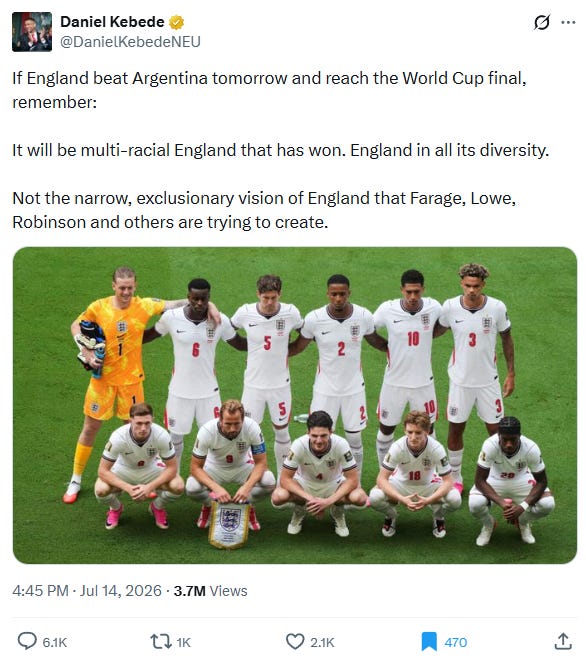
As discussions around what it means to be English or British and the impending future where White British people will become a minority in Britain by 2063, for some the diverse appearance of their national teams are a visual reminder of demographic change.
Backlash
It was almost inevitable that there would eventually be a backlash, both against diversity generally and in football specifically. Despite suppression, or perhaps because of it, there have been signs of a revival of patriotism in the last few years. Hundreds of thousands, perhaps even a million, people turned out for Tommy Robinson’s Unite the Kingdom rally last September and again this May. While Tommy Robinson is a civic nationalist, and therefore not against ethnic diversity, this open display of patriotism spooked the media class. British people were displaying patriotism outside of their permitted bounds of football matches.
The Raise the Colours campaign saw lampposts up and down the country adorned with the St George’s flag and roundabouts painted with it. It’s easy to forget that this was largely a reaction to the way Palestinian flags could be flown everywhere but not English flags.
It’s also important to note that the supporters of both campaigns were mostly working class. The media class who decried the UTK march were middle-class professionals. The people caught on camera taking down English flags almost always had middle-class accents. Middle-class patriots do, of course, exist. Those afraid to show any outward signs of love for their country due to social stigma can be counted among the ranks of voters for Britain’s rising right-wing parties.
The launch of Restore Britain, a party which is unashamedly for the British people first, and which doesn’t shy away from asserting that an English ethnic identity exists, has emboldened more people to speak openly about their fears over demographic change. It has forced more established political parties to discuss the topic.
Then the World Cup arrived. The ethnic composition of the team became a topic of debate. As for many years, establishment bodies and left-leaning members of the public eagerly pointed out how many of England’s top players were not ethnically English. But more voices than before challenged the underlying assumptions behind these boasts, questioning the logic of suggesting ethnically English players wouldn’t be good enough and whether it is really the England team if a large portion of the players are ethnically African.
And a new debate emerged: should those who protest against demographic change support this England team? Should someone support an organisation which is used to push messages they disagree with? Which is the more patriotic option: supporting England or boycotting the tournament?
Forced to think
The societal-wide campaigns to make the public aware of the racial and cultural identity of minorities have, very predictably, led to more English people than before thinking about their own ethnic identity. We have seen this play out in the reaction to the England football team and its performance.
Perhaps it would have been better for those wishing to turn England into a multicultural country without backlash to have left football alone. The sport could have remained a vector to distract the English from politics and thus not resist the cultural and demographic change of their country. Inserting messaging into the game has made it political. Therefore, football was not going to escape the backlash against pro-diversity messaging.
Football fans have been forced to consider questions of identity, ethnicity and culture. While undoubtedly some have become strong supporters of diversity (football accounts on X are notorious for their left-wing, pro-diversity comments), others have weighed up the questions and come down on the other side of the argument. This may well convert into votes for right-wing, anti-immigration parties.
Sporting bodies and media networks changing the “bread and circuses” of football from a distraction into a means of instruction may well have backfired terribly. Rather than moulding all football fans into supporters of multiculturalism and anti-racism, they may well have radicalised some of them in the opposite direction.
Thank you for reading! If you’d like to see more of my writing, please subscribe.
If you’d like to support me, you can also make a donation through Buy Me a Coffee.
You can find me as JournoMaddie on X, Instagram and YouTube.